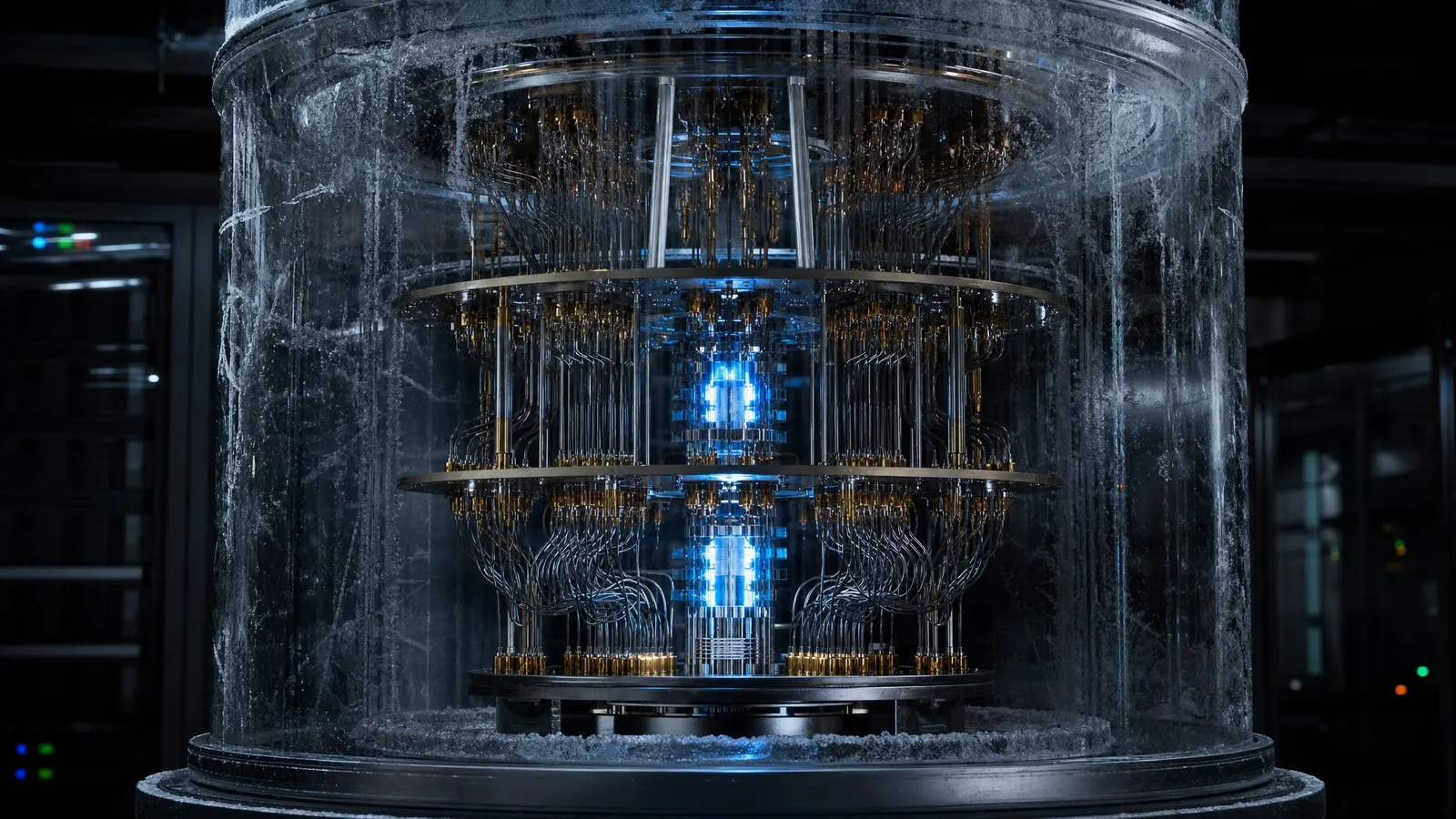
As investors pour capital into quantum computing and advanced semiconductors, the cryogenic system market is becoming harder to ignore. The race to build fault-tolerant quantum computers is fundamentally a race to get colder, measure cleaner signals, and keep hardware stable for longer. That makes ultra-low temperature refrigeration, cryogenic measurement, helium handling, and lab infrastructure a practical pick-and-shovel theme for the quantum industry.
This post contains affiliate links. We may earn a small commission at no extra cost to you. Quick Answer: The cryogenic system market matters to quantum investors because superconducting quantum computers, quantum sensors, semiconductor research tools, and advanced physics labs all depend on reliable ultra-cold infrastructure. The best public-market approach in 2026 is to watch industrial gas companies with cryogenic supply chains, scientific instrument makers, and semiconductor-adjacent test equipment suppliers. Key names include Linde plc (LIN), Air Products and Chemicals (APD), and FormFactor (FORM) through its cryogenic measurement exposure.Cryogenic System Market: What Investors Should Track
The cryogenic system market is broader than quantum computing, which is exactly why it can be interesting. Quantum labs are not the only buyers. Demand also comes from semiconductor research, aerospace, medical imaging, fusion experiments, national labs, and advanced materials work. That gives some suppliers revenue diversity while the quantum timeline remains uncertain.
For quantum-focused investors, track four market signals:
| Signal | Why it matters |
|---|---|
| Dilution refrigerator orders | A direct proxy for superconducting quantum and low-temperature physics lab expansion |
| Helium supply and pricing | Affects operating costs and margins for systems that depend on liquid helium |
| Semiconductor and research-tool demand | Gives suppliers revenue outside pure quantum computing |
| Public quantum hardware roadmaps | Shows whether more qubits also mean more cooling capacity, wiring, shielding, and test gear |
The clean thesis is not "buy every company with cryo in the description." It is that quantum hardware scaling may pull more spending into specialized cooling systems, measurement platforms, and lab infrastructure before large-scale quantum revenue fully arrives. For the wider supplier map, pair this guide with our overview of quantum infrastructure stocks in 2026.
Why Cryogenics is a Critical Investment Theme for 2026
Most leading quantum computing architectures, particularly those based on superconducting qubits, require operating temperatures near absolute zero (0 Kelvin or -273.15°C). Maintaining these temperatures is non-negotiable for achieving the stable quantum states, or "coherence," needed for computation. Without advances in cryogenics, there is no quantum computing at scale.
This dependency creates a durable demand cycle for:
- Dilution Refrigerators: The gold standard for reaching the millikelvin temperatures needed for superconducting quantum processors.
- Cryocoolers: Used for a wide range of applications, including cooling quantum sensors and components.
- Industrial Gases: Liquid helium and nitrogen are the lifeblood of cryogenic systems.
- Specialized Components: Cryogenic pumps, wiring, and measurement tools are all essential parts of the ecosystem.
As quantum hardware companies scale from small, experimental systems to larger, commercially viable machines, their demand for cryogenic infrastructure will grow exponentially. This positions cryogenics as a foundational layer of the entire deep-tech stack.
Key Players in the Cryogenics Market
The cryogenics market is a mix of large industrial giants and smaller, highly specialized firms.
The Industrial Gas Titans
- Linde plc (LIN): A global leader in industrial gases, including helium, which is critical for cooling. Their engineering division builds cryogenic processing plants, giving them deep expertise across the entire value chain.
- Air Products and Chemicals, Inc. (APD): Another major player in industrial gases, APD provides liquid helium and nitrogen and has a strong presence in the electronics and semiconductor manufacturing industries.
For investors, these giants offer stability and diversification. While not pure-play cryogenics bets, their scale and critical role in the helium supply chain make them direct beneficiaries of quantum industry growth.
The Pure-Play and Semiconductor-Adjacent Players
- FormFactor, Inc. (FORM): Primarily known for semiconductor probe cards, FormFactor has built a strong position in quantum through acquisitions. They provide cryogenic measurement and testing systems essential for R&D.
- Cryomech: A private company, but one to watch. They are a key manufacturer of Gifford-McMahon and Pulse Tube cryocoolers used in research labs worldwide. Their success is a leading indicator of the health of the R&D ecosystem.
A great primer on the physics and engineering behind these systems can be found on the National High Magnetic Field Laboratory's website, which provides an authoritative, non-commercial overview.
How to Analyze Cryogenics Companies
Evaluating cryogenics stocks requires a different lens than software or even other hardware companies.
- Segment Revenue Exposure: For giants like Linde, dig into their annual reports to determine what percentage of their revenue comes from electronics, healthcare, and research. Growth in these segments is your best proxy for deep-tech demand.
- R&D and IP Moat: Look for companies with a strong portfolio of patents in dilution refrigeration and cryocooler technology. This is a field driven by engineering and physics expertise. For a deep dive into building a defensible business, Michael Porter's "Competitive Strategy" provides the essential framework for analyzing industry structure and competitive advantage.
- Customer Base: Are they selling to university labs, or do they have major contracts with companies like IBM, Google, or Rigetti? Landing a major quantum hardware firm as a customer is a significant validation of their technology. Check our analysis of the broader quantum hardware race to see who the key customers might be.
- Supply Chain Control: Helium is a finite resource. Companies with strong control over their helium sourcing and distribution have a significant long-term advantage.
Risks and Challenges in the Cryo Sector
Investing in cryogenics isn't without risk. The primary challenge is that the timeline for large-scale, fault-tolerant quantum computing remains uncertain. A slowdown in quantum hardware development would directly impact demand for high-end cryogenic systems.
Furthermore, the dependence on helium presents a major supply chain risk. Helium shortages or price spikes can significantly impact margins for companies that rely on it. Investors should monitor helium market dynamics closely.
Finally, while superconducting qubits currently dominate the headlines, other quantum computing modalities like trapped ions or photonics have less stringent or no cryogenic requirements. A breakthrough in a different modality could reduce the total addressable market for cryogenics companies. A good investor understands all sides of the hardware competition, as detailed in our guide to IONQ vs. Rigetti.
FAQ
Is it better to invest in cryogenics stocks or quantum computing stocks directly?
Investing in cryogenics stocks is a "pick-and-shovel" strategy. You are betting on the growth of the overall quantum industry rather than trying to pick the winning quantum computer architecture. This is generally a lower-risk approach, as cryogenics companies will sell to whoever is building hardware. Direct investment in a quantum computing company carries higher risk but also potentially higher reward if you choose the winner.
How big is the market for cryogenics in quantum computing?
The market is still nascent but growing rapidly. While the total cryogenics market is a multi-billion dollar industry, the segment specifically serving quantum computing is in the hundreds of millions. However, analysts project this sub-market to grow at a CAGR of over 30% for the next five years as quantum computers scale up.
Are there any cryogenics ETFs?
Currently, there are no ETFs that focus exclusively on cryogenics technology. Investors looking for diversified exposure would need to either buy a basket of individual stocks like LIN, APD, and FORM, or invest in a broader industrial or technology hardware ETF that may have some allocation to these names.