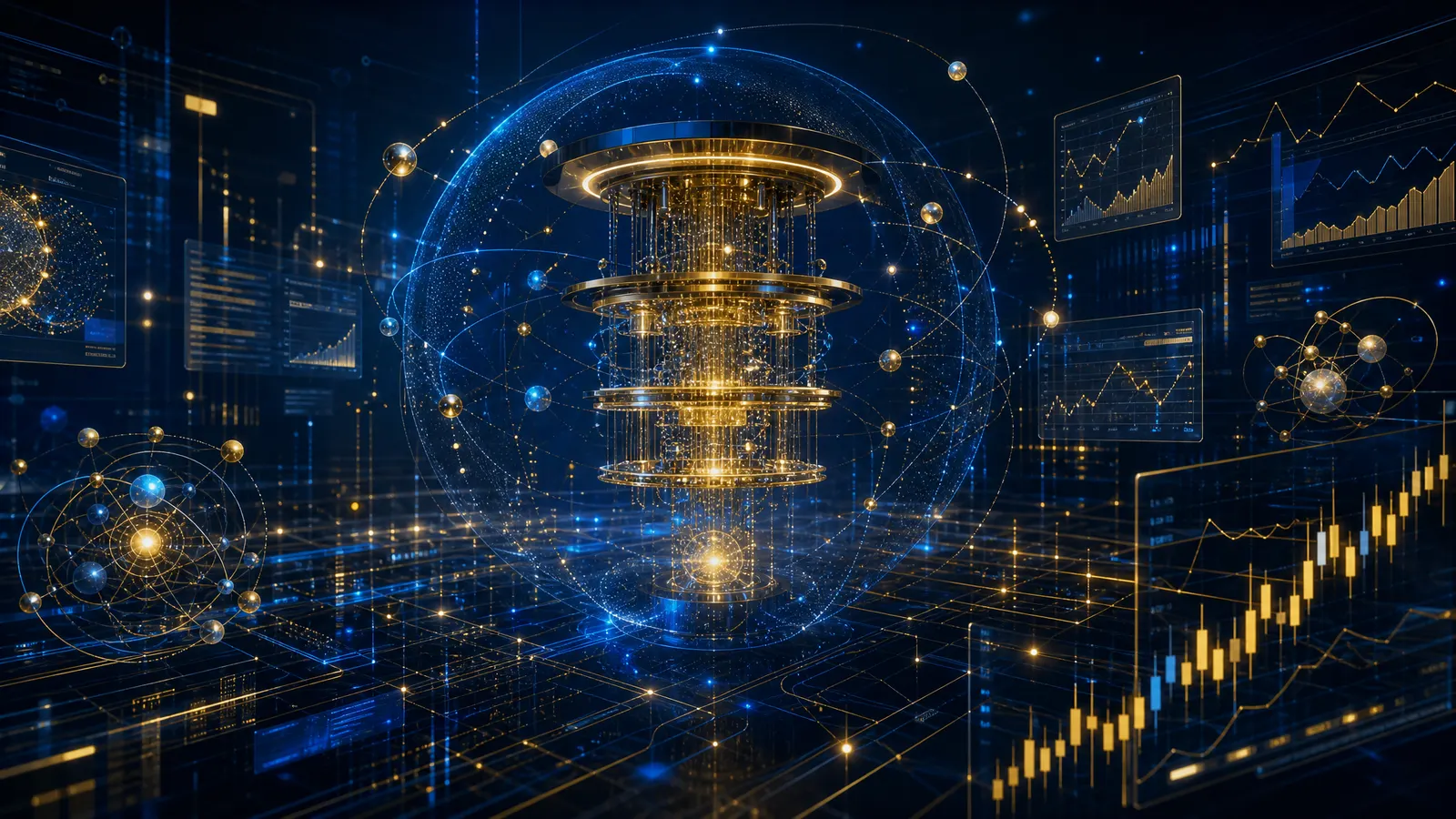
For decades, artificial intelligence has been advancing at a blistering pace, powered by classical computers that store and process information in bits—ones and zeros. But we are rapidly approaching the edge of what classical computing can achieve. Enter quantum computing, a revolutionary paradigm that promises to unlock unprecedented computational power and redefine the boundaries of AI.
This post contains affiliate links. We may earn a small commission at no extra cost to you.The Synergy Between Quantum and AI
The relationship between quantum computing and AI is not just complementary; it's synergistic. AI, particularly machine learning, relies on processing vast datasets to identify patterns, make predictions, and learn. As datasets grow in complexity, classical computers struggle to keep up. Quantum computers, on the other hand, operate on the principles of quantum mechanics, using qubits that can exist in multiple states simultaneously (superposition) and are interconnected (entanglement). This allows them to perform complex calculations at speeds unimaginable for even the most powerful supercomputers today.
This opens up several exciting frontiers for what is now being called Quantum AI.
1. Supercharged Machine Learning Algorithms
Many machine learning algorithms are fundamentally optimization problems. Finding the best solution from a sea of possibilities is computationally expensive. Quantum algorithms, like the Quantum Approximate Optimization Algorithm (QAOA) and quantum annealing, are naturally suited for these types of problems.
This could dramatically accelerate training times for complex neural networks, enabling the development of more sophisticated and accurate AI models. For those looking to dive deeper into the foundational concepts, a great resource is the book A First Introduction to Quantum Computing and Information, which lays out the core principles in an accessible way.
2. Enhancing Complex Data Analysis
Quantum computers can analyze complex patterns and correlations in data that are completely invisible to classical systems. This has profound implications for fields like finance, materials science, and drug discovery. For example, a quantum-enhanced AI could analyze financial markets with incredible precision, identifying investment opportunities that are impossible to spot today.
Investors keen on staying ahead of the curve are already exploring this new technological wave. Platforms like eToro are becoming popular for trading a diverse range of assets, including tech stocks and ETFs that could be influenced by the quantum revolution.
3. Creating More Advanced AI Models
Quantum mechanics can inspire entirely new types of neural networks. Quantum neural networks (QNNs) leverage quantum phenomena to create models that can, in theory, solve problems that are intractable for classical AI. This could lead to breakthroughs in areas like natural language processing, computer vision, and the creation of truly intelligent systems. The development of these models is a complex and fascinating field, often explored in advanced courses on platforms like Coursera, which offer specialized tracks in both AI and emerging technologies.
The Road Ahead: Challenges and Opportunities
The era of full-scale, fault-tolerant quantum computers is not yet upon us. Building and maintaining stable quantum systems is an immense engineering challenge. Decoherence, where qubits lose their quantum properties due to environmental interference, remains a significant hurdle.
However, the progress is undeniable. Companies like Google, IBM, and Rigetti are making significant strides, and a new ecosystem of startups is emerging. For investors and technologists, the convergence of quantum and AI represents one of the most significant opportunities of the 21st century. Keeping up with the latest developments is key, and reading comprehensive books on the subject, such as Quantum Computing for Everyone, can provide a solid foundation for understanding this transformative technology.
While the quantum AI revolution is still in its early stages, its potential is undeniable. As the technology matures, it will undoubtedly reshape our world, creating new industries and solving some of humanity's most pressing problems.